Wednesday, November 2, 2011

Indium

The element Indium can not be found in deposits or veins like similar metals. Instead, Indium is commonly found enriched in lead, tin, iron, copper, and predominately zinc ore. After melting the ore Indium is extracted from the slag via electrolysis.

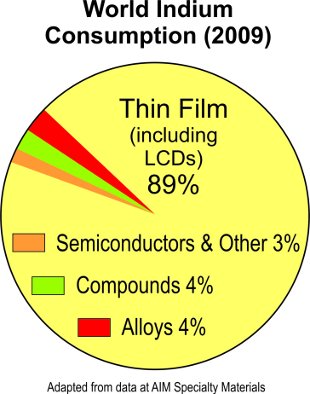
Initially the element was used as lubrication for complex aircraft engines during World War II but by the 1980's it was largely used in the production of Liquid Crystal Displays and semiconductors.
http://adexmining.com/images/metal-charts/world%20indium%20use%202009.jpg

Because Indium Oxide could both conduct electricity and remain transparent it is the favored product for LCD televisions and touchscreen devices. In addition, it was generally concluded that Indium was relatively nontoxic. However recent studies have begun to reveal that exposure to Indium may in fact be very toxic given certain conditions.

Potential circumstances for inhalation exposure to ITO:
1. ITO target creation
2. ITO film deposition
3. ITO recycling

What this means is that ITO is toxic during its creation, during the deposition of the ITO crystal sheet onto a medium, and when consumers recycle. However, unless you work near the production of ITO you are at a relatively low risk of exposure.

Several cases in Japan have been examined where workers were adversely affected by exposure to ITO and eventually died. In 2003, the first study on the toxicity of Indium was done in after a wet surface grinder developed interstitial pneumonia and eventually pneumothorax, which was the cause of death. His lungs contained high levels of ITO particles and serum indium.

In addition other cases were examined and it was demonstrated that workers who were occupationally exposed to Indium developed interstitial pulmonary disorders, increased serum indium, and increased levels of KL-6, which is a marker of interstitial lung injury.

These studies lead Japanese Corporations to tighten safety regulations in areas where workers would routinely be exposed it Indium and ITO.

In a study done in 2009 it was determined that Indium Tin Oxide (ITO) was toxic when applied to rats both in vitro AND in vivo via inhalation.

Despite, the potential toxicity of Indium it is still commonly used in nearly every electronic product you can imagine from televisions to ipods. This is because there is a very low risk for exposure during every day activities.

Tuesday, October 18, 2011

The RCRA

The RCRA or the Resource Conservation and Recovery Act was implemented in 1976 to replace the aging Solid Waste Disposal Act of 1965. It set the precedent for handling the increasing problems America faced from its growing volume of municipal and industrial waste. The RCRA addresses the issues of protecting human health and the natural environment from the potential hazards of waste disposal as well as reducing the amount of waste generated, through source reduction and recycling thus ensuring the management of waste in an environmentally sound manner.

The RCRA consists of 10 subsections each addressing its own issues.

Subtitle A: General Provisions

Subtitle B: Office of Solid Waste; Authorities of the Administrator

Subtitle C: "Cradle to Grave" requirements

Subtitle D: Non-hazardous Solid Wastes

Subtitle E: Dept of Commerce Responsibilities

Subtitle F: Federal Responsibilities

Subtitle G: Miscellaneous Provisions

Subtitle H: Research, Development, Demonstration and Information

Subtitle I: Underground Storage Tanks


Today the RCRA is far different from its original form. It has been amended countless times. The Federal Hazardous and Solid Waste Amendments were added in 1984 and focused on waste minimization and phasing out land disposal of hazardous waste. Some of the other mandates of these amendments include increased enforcement authority for the EPA and more stringent hazardous waste management standards. Originally the RCRA did not include the subsection on Underground Storage Tanks but it was amended in 1986 to allow the EPA to address environmental problems that could result from underground tanks storing petroleum and other hazardous substances. 

As well as addressing each of these issues the RCRA is responsible for the management of all waste disposal sites. This means that public landfills, incinerators, and sewage treatment plants (also known as TSDF's or Treatment, Storage, and Disposal Facilities) are all managed by organizations such as the EPA.


Thursday, October 6, 2011

For your consideration..

I did my fact sheet on a technology that I think has a potential to positively impact the world. Plasma Arc technology will allow us to literally turn our waste into energy. The fact sheet will discuss exactly how this technology works and if you are interested in learning more feel free to download a copy.


http://www.mercer.edu/enp/enp305/jp_fact_sheet.pdf

Tuesday, September 6, 2011

Native American Ethics

When we discussed the topic of nature ethics in class my first thought was of the Native American indians. Throughout history they have been portrayed as the defenders of the wilderness. Personally I believe that it is due to a deep, almost spiritual, relationship that they maintained with nature. This relationship has been portrayed in countless films and books. Below I have included a link to a very famous Public Service Announcement from the 1970's that urges people to stop polluting.


http://www.youtube.com/watch?v=j7OHG7tHrNM&feature=related

This commercial raised national awareness about the pollution epidemic and although the actor was not actually a Native American it conveys the utmost sense of respect that they had for the planet.

Finally, I have linked a website at the bottom of this entry that includes a traditional code of ethics for a Native American indian tribe. As you read it think about the system that governed the tribes and how they have related their sense of respect not only to each other but also to the world around them. Remember, this precedes the development of any sort of environmental ethic in the United States by several hundred years.

http://www.sapphyr.net/natam/nacodeethics.htm