Initially the element was used as lubrication for complex aircraft engines during World War II but by the 1980's it was largely used in the production of Liquid Crystal Displays and semiconductors.
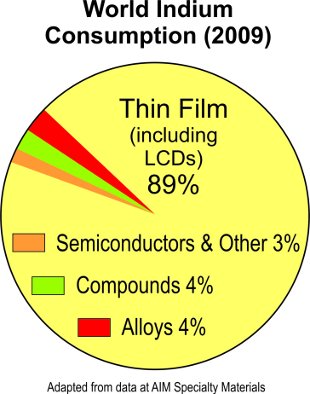
Because Indium Oxide could both conduct electricity and remain transparent it is the favored product for LCD televisions and touchscreen devices. In addition, it was generally concluded that Indium was relatively nontoxic. However recent studies have begun to reveal that exposure to Indium may in fact be very toxic given certain conditions.
Potential circumstances for inhalation exposure to ITO:
1. ITO target creation
2. ITO film deposition
3. ITO recycling
What this means is that ITO is toxic during its creation, during the deposition of the ITO crystal sheet onto a medium, and when consumers recycle. However, unless you work near the production of ITO you are at a relatively low risk of exposure.
Several cases in Japan have been examined where workers were adversely affected by exposure to ITO and eventually died. In 2003, the first study on the toxicity of Indium was done in after a wet surface grinder developed interstitial pneumonia and eventually pneumothorax, which was the cause of death. His lungs contained high levels of ITO particles and serum indium.
In addition other cases were examined and it was demonstrated that workers who were occupationally exposed to Indium developed interstitial pulmonary disorders, increased serum indium, and increased levels of KL-6, which is a marker of interstitial lung injury.
These studies lead Japanese Corporations to tighten safety regulations in areas where workers would routinely be exposed it Indium and ITO.
In a study done in 2009 it was determined that Indium Tin Oxide (ITO) was toxic when applied to rats both in vitro AND in vivo via inhalation.
Despite, the potential toxicity of Indium it is still commonly used in nearly every electronic product you can imagine from televisions to ipods. This is because there is a very low risk for exposure during every day activities.
